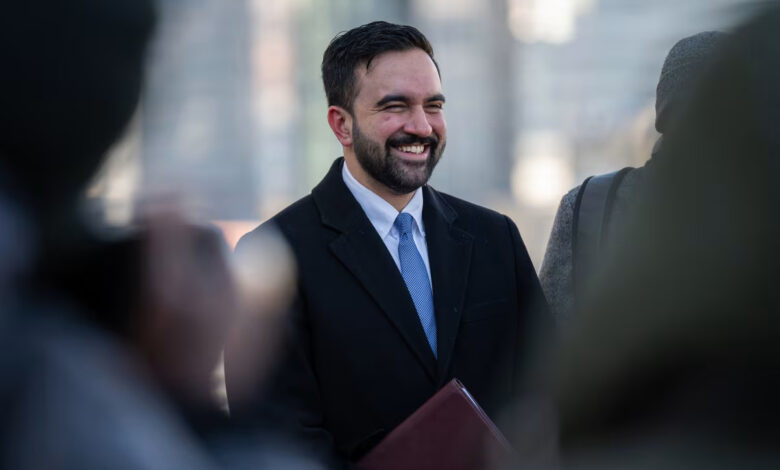
Mayor Zohran Mamdani wants to tackle huge problems in New York City like housing, mass transit and child care.
His starting point? Public bathrooms.
There’s a shortage in New York —just one bathroom for every 8,500 residents. Many are musty and the toilets don’t flush. Some double as shelter for homeless people.
When you can’t find a restroom, “you are made keenly aware of just how few public bathrooms there are and how dependent we have left New Yorkers on either the generosity and kindness of a business owner or a requirement that they pay seven bucks for a coffee,” Mamdani told CNN.
Mamdani is tackling the grimy issue weeks into his tenure to try to prove that government can still solve problems in people’s lives. For the 34-year-old democratic socialist, the dismal state of bathrooms is symbolic of a larger failure to build and sustain public goods in America.

If people are forced to rely on Starbucks or McDonald’s to provide an essential service like bathrooms, they doubt political leaders can take on bigger challenges like the cost-of-living crisis, he said.
“We cannot isolate these incidents where the public loses trust in government’s ability to deliver on their day-to-day needs from the public losing trust in government’s ability to deliver on its most ambitious projects,” he said. “These are part and parcel of the same problem.”
Mamdani recently marked the opening of a new bathroom and pledged $4 million of city funding to build 20 to 30 new modular public toilets around the city.
“This has to be the start of showing what competent government can actually look like,” he said. “Every time you deliver on this, you are making the best case for New Yorkers to believe in government’s role as a positive force.”
Disappearing public bathrooms
America’s bathroom access looks more like a developing nation— it has only eight public toilets per 100,000 people, tied for 30th in the world with Botswana.
New York is one of a growing number of city governments trying to address their bathroom void, which creates public health risks and undermines quality of life.
Food delivery workers and street vendors are forced to urinate into bottles. People with bladder and other health conditions struggle to travel around in public. Hepatitis A outbreaks have been linked to poor bathroom access in Philadelphia, San Diego and other places.
The lack of public bathrooms is a “manifestation of economic inequality,” Mamdani said.
The bathroom shortage also costs money. San Francisco has spent tens of millions of dollars annually cleaning up feces off the streets. Shopping districts, parks and other public places lose out when visitors leave because they can’t find a place to do their business.

“We hit the nadir,” said Bryant Simon, a historian at Temple University and author of a forthcoming book on public bathrooms. “There’s now a re-municipalization of public bathrooms because what we have now is unsustainable.”
Local governments are trying to build bathrooms like they did in the middle of the nineteenth century, when health concerns about the spread of disease and the foul stench from people urinating on the streets spurred efforts to install public toilets.
Temperance leaders also advocated for public bathrooms to keep men out of bars, which were one of the only establishments with restrooms. Cities later raced to build public bathrooms ahead of Prohibition to mitigate the impact of bar closures.

But cities never fully accomplished a vast network of public bathrooms. New York and other cities closed bathrooms and cut public services to close budget holes during the 1970s and 1980s.
And for years, public bathrooms have been flash points for battles over race, gender and other social issues, making it harder to win broad public support for investment.
Desegregating public restrooms was a major goal of civil rights campaigns during the 1950s and 1960s. Police targeted restrooms to arrest gay men during the same period. And transgender bathroom access has been a contentious issue over the last decade.
Modular toilets
Public bathrooms can cost millions of dollars and take years to complete because they must hook up to sewage, water and power lines buried deep underground.
New York, San Francisco and other cities have attempted to build them over the last few years, but their projects have ended in embarrassment.
San Francisco in 2022 spent $1.7 million on a single public toilet. It became a punchline for late-night comedy shows, with some calling it “Toiletgate.”
New York Mayor Michael Bloomberg announced a plan to install 20 automated public toilets around the city in 2006, but only five were ever installed. They were bogged down in local community board meetings and extensive public review.

New York City is putting out bids to vendors to install and maintain modular toilets, which are usually cheaper to build because they don’t need to be hooked up to utilties.
Throne Labs is one company that plans to vie for New York’s bathroom contracts.
Throne installs and cleans the bathrooms for cities for about $100,000 a year. People use their phone to enter Throne’s bathrooms, and motion sensors monitor the facilities.
Building bathrooms is unglamorous work and “doesn’t always have a ribbon cutting,” Mamdani said. But it is a sign of effective government.
“What it means is that city government is actually doing its job so that people can live their lives with just a little bit more ease.”