It was the nightmare before Christmas.
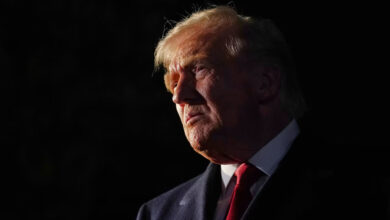
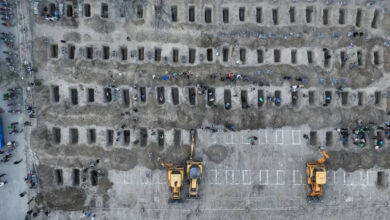
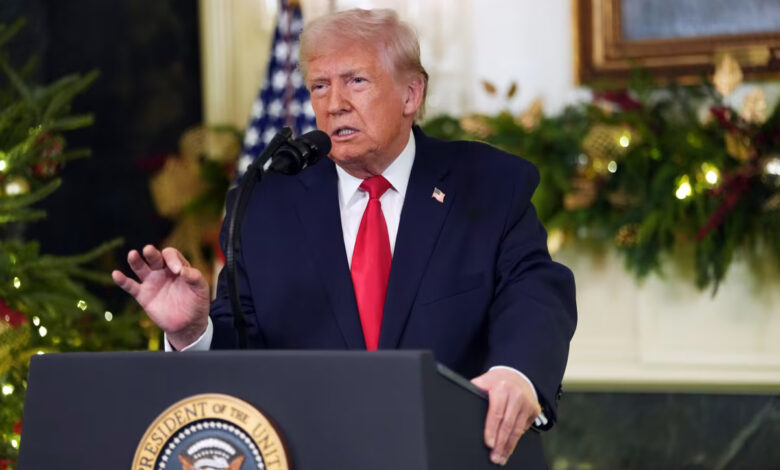
Donald Trump put a dark new spin on the tradition of national presidential addresses Wednesday, conjuring a hellscape of a “dead” nation he claims he was handed by former President Joe Biden.
His goal was obvious — to distract from his own political slump.
Presidents often ask television networks for airtime for a prime-time address at epochal moments — when they are about to take the nation to war, or after tragedies.
In 2003, President George W. Bush came before the nation to announce that “at this hour, American and coalition forces are in the early stages of military operations to disarm Iraq.”
In January 1986, President Ronald Reagan mourned seven astronauts lost in the Space Shuttle Challenger disaster in sublime language, saying they’d “slipped the surly bonds of Earth to touch the face of God.”
Trump’s Yuletide message lacked such poetry. Instead, he shouted out a seasonal dose of his most dystopian rhetoric. The only crisis is the one that has pulled his approval rating down to 39%, according to CNN’s Poll of Polls, after less than a year back in office.
“I inherited a mess, and I am fixing it,” Trump bellowed. Americans hoping for recognition and empathy about their struggles with high prices for food, housing and health care instead got a dressing-down for not recognizing that they are basking in a glorious new golden age of his making.
“Over the past 11 months, we have brought more positive change to Washington than any administration in American history. There has never been anything like it, and I think most would agree,” Trump declared.
Trump’s speech, which opened with a searing anti-immigrant blast, was familiar to anyone who’s attended one of his rallies. And it probably went down well with the super-loyal base voters with whom he has a deep bond.
Trump did not look like a leader in control of either his own political fate or the nation’s destiny. Instead, his speech was like one of his block-capitals Truth Social screeds come to life. But it also doubled down on a fundamental political mistake — one that was also made by Biden. Trump tried to force Americans to reject the evidence of their own eyes as they struggle with high prices and a pervasive sense of economic insecurity never felt by billionaires like him.
He rattled off a list of statistics, claiming that prices were falling fast, that wage growth was spiking upwards and that millions of Americans were far better off than they were when he took office. Much of this data was exaggerated or wrong. The president also ignored that the year-over-year inflation rate is exactly the same as when he took office. Grocery prices aren’t down across the board. Millions of Americans are getting huge price hikes for health insurance because his administration has failed to find a solution for expiring enhanced Obamacare premiums. And the unemployment rate just hit a four-year high, with sluggish wage growth further souring the public’s mood.

Where Trump’s skills may be failing him
Trump, perhaps the greatest branding expert in American political history, has had considerable success in reinventing reality in the past. He convinced millions of citizens, for instance, of his false claims that the 2020 election was stolen.
On Wednesday, his task was to convince people that he’d made progress in easing their plight and that much better was around the corner in 2026. And he left no doubt of his message that anything still going wrong is Biden’s fault. But telling people over and over again that things are great, in an increasingly loud voice, seems like a political strategy doomed to failure.
And while the Biden administration got a lot wrong — in downplaying an historic inflation crisis, for instance — Trump is likely to see diminishing returns for incessantly dumping on his predecessor. So will vulnerable Republicans in midterm elections next November. According to a new Quinnipiac University poll, 57% of Americans say that Trump is more responsible for the current state of the economy, while 34% blame former President Biden.
Trump beamed into the nation’s living rooms, and onto its mobile phones, at perhaps his most challenging political moment across two presidential terms. His approval ratings are tumbling. He’s lost public faith in his ability to manage an economy that is showing all kinds of danger signs. He’s declared voter worries about affordability a “hoax” — a smear he did not repeat on Wednesday.
There’s also a sense that the iron grip of a president who built his brand on dominance, and who seeks limitless executive power, is slipping. Trump has recently suffered revolts from Republicans in Congress over the Jeffrey Epstein files and from Indiana Republicanson his midterms gerrymandering effort. In a stunning comment, one of his formerly most loyal supporters, Georgia Rep. Marjorie Taylor Greene, told CNN this week that “the dam is breaking” in the GOP and that Trump was becoming a lame duck.
The best that could be said for Trump’s effort on Wednesday is that he was doing what he always does: appealing to his base. If Trump’s most enthusiastic voters don’t show up in November, Republicans’ hopes of keeping their narrow House of Representatives majority will be sunk. Trump made a case that his mass deportation policy, hardline approach to crime and “America First” foreign policy had restored public safety and global respect.
This will please grassroots Republicans. But after Wednesday night’s angry lecture, Democrats might be more delighted to have Trump metaphorically insert himself on the 2026 ballot than GOP leaders.
After he went off air, the president chatted with reporters in the White House, sipping a Diet Coke and revealing that he’d been asked to give a televised address by his chief of staff, Susie Wiles. “I told you 20 minutes, and you were 20 minutes on the dot,” Wiles told the president. Maybe that explains why he raced through the speech like he had a plane to catch.

All is not lost for Republicans — but things need to change
As well as being the loudest televised presidential address to the nation in recent memory, Trump’s appearance was one of the most defensive.
He sounded genuinely angry that people aren’t more appreciative of his attempts to lower drug prices, his executive order seeking to making housing more affordable and his bid to make Americans safer with his controversial strategy of sending National Guard troops into cities such as Washington, DC.
But self-pity is rarely a winning political quality. And telling off voters is a strange way to win their support.
The die is not definitively cast ahead of next year’s midterms or on Trump’s second-term legacy. Many presidents before him have struggled with messaging around testing economic times. And some regained political traction.
A more temperate tutorial on areas where Trump has succeeded — lowering gas prices, for example — might have been a wiser course for the president. He does have some reason to hope that the tide will turn in 2026. His tax cuts will kick in with the turn of the year and could improve the mood of voters. The $1,776 bonus for members of the military he announced on Wednesday will strike many Americans as laudable and patriotic.
And if the Federal Reserve Chief he nominates brings down interest rates more quickly than the central bank’s current Chair Jerome Powell, people might get cheaper mortgages. (This move could also backfire and trigger faster inflation, sending prices up again.)
Moreover, the same polls that show Trump is unpopular also reveal that voters still don’t put much faith in Democrats, despite the party’s big wins this year in the New Jersey and Virginia gubernatorial races, in which affordability was a major theme.
But there are deep challenges ahead. The costs of groceries, rent, mortgages, childcare, health care and electricity are all rising faster than wage growth. And Trump partly made this problem for himself: He promised on the campaign trail in 2024 that he’d bring down the cost of living, and he said it would be easy.
And Trump showed on Wednesday night that he won’t change one policy that many economists think is ruinous to the economy and key to rising prices.
“Much of this success has been accomplished by tariffs. My favorite word, ‘tariffs,’ which for many decades have been used successfully by other countries against us, but not anymore,” Trump said. There is some evidence that tariffs have convinced some firms to relocate to the US — in the auto industry, for instance. But new plants and investment will take years to make an impact and won’t appease voters who want change now.
Trump ended his appearance by spelling out the message Republicans will take to the voters next year, and that he’s likely to sketch out in more detail in his State of the Union address next year.
“We are making America great again. Tonight, after 11 months, our border is secure. Inflation has stopped, wages are up, prices are down. Our nation is strong. America is respected, and our country is back stronger than ever before. We’re poised for an economic boom the likes of which the world has never seen.”
It’s one thing to say it. It’s another to make the country believe it.