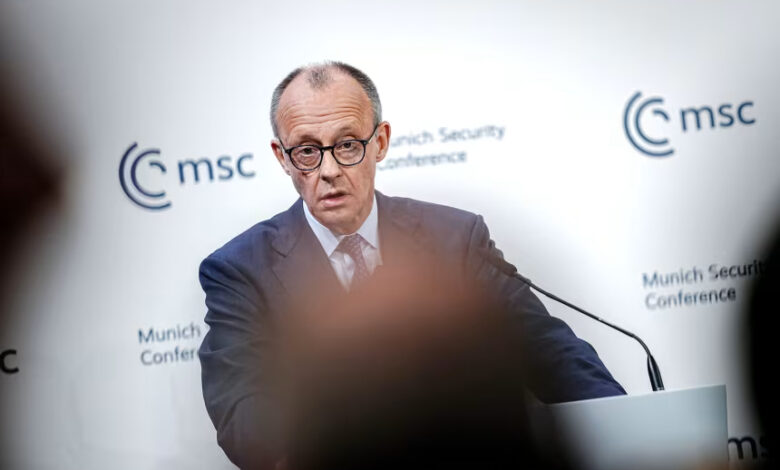
European leaders focused on the end of the US-led international order on Friday at a combative Munich Security Conference – one of the few points of agreement between Washington and its NATO allies.
German leader Friedrich Merz said the post-1945 settlement “no longer exists” in his opening remarks, but warned leaders of the United States it has reached the limits of its power when acting alone, with its global leadership slipping away.
He also disclosed that he had begun talks with France about a European nuclear deterrent, while French President Emmanuel Macron said Europe “has to become a geopolitical power” in the face of Russian aggression.
Merz’s speech at the gathering in southern Germany, which brings together officials from across the world to discuss international security and hold diplomatic talks, highlighted the growing divide between the United States and Europe.
The German leader, of the center-right Christian Democratic Union party, warned that Europe’s freedom “is no longer a given” in an era of big powers ignoring international rules. He condemned Russia’s war against Ukraine, calling for Europe to invest in strengthening its own deterrence. And he openly criticized US President Donald Trump’s administration for its policies on tariffs, climate change and culture wars – remarks that may ruffle feathers in Washington.
But on the demise of the previous world order – underwritten by US-led institutions and alliances – Washington seems in sync.

US Secretary of State Marco Rubio said Thursday night as he departed for Munich that “the old world is gone, frankly” and “we live in a new era in geopolitics.”
“It’s going to require all of us to sort of re-examine what that looks like and what our role is going to be,” Rubio added, also noting that Europe is important to the US. “I think they want honesty. They want to know where we’re going, where we’d like to go, where we’d like to go with them.”
The next day, Merz was indeed honest in his assessment of the transatlantic relationship.
“A divide has opened up between Europe and the United States,” Merz said.
“The United States’ claim to leadership has been challenged, and possibly lost,” he said.
The German chancellor went on to offer a sort of rebuttal to the combative speech made by US Vice President JD Vance at last year’s conference. Vance’s 2025 remarks lambasted European politicians, claiming they were suppressing free speech, losing control of immigration and refusing to work with hard-right parties in government.
One year on, Merz hit back, saying, “The battle of cultures of MAGA in the US is not ours. Freedom of speech, here (in Germany), ends where the words spoken are directed against human dignity and our basic law.”
“We do not believe in tariffs and protectionism, but in free trade,” Merz added, a line that was met with loud applause.
“We stick to climate agreements and the World Health Organization, because we are convinced that global challenges can only be solved together,” he said to more applause.
Those comments come after the Trump administration increased tariffs on the European Union and United Kingdom in 2025, as well as pulling out of the Paris climate agreement and the WHO.
The German chancellor then switched to English, with a sharp warning aimed at US leadership, but also a call to repair transatlantic relations.
“In the era of great power rivalry, even the United States will not be powerful enough to go it alone,” Merz cautioned. “Dear friends, being a part of NATO is not only Europe’s competitive advantage, it’s also the United States’ competitive advantage.”
Another point of alignment between the US and Europe emerged as Macron endorsed Trump’s pursuit of a negotiated peace in Ukraine, “one that should be just, lasting, and robust.”
He cautioned, however, that yielding to Russian demands is not the solution, later adding “we have our own European interests to defend in this, especially when it comes to the future of strategic stability on our continent.”
On what should follow the dissolution of the US-led Western order, Macron said Europe needed to stand alone.
“In this new geopolitical environment, Europe has to become a geopolitical power,” he said.
“It’s ongoing, but we have to accelerate and clearly to deliver all the components of a geopolitical power in defense, in technology, and in the de-risking vis-a-vis all the big powers in order to be much more independent.”
Rubio is scheduled to address the conference on Saturday.
Merz and Rubio met on the sidelines of the conference on Friday, in which they discussed the Ukraine war and the status of negotiations with Russia to end the conflict, according to US and German government sources.
Rubio expressed appreciation for Germany’s strong support for Ukraine, including $76 billion in assistance since 2022, US State Department deputy spokesperson Tommy Pigott said.
As they spoke about Europe’s role in NATO, Rubio acknowledged Germany’s efforts to strengthen the alliance, a German government source told CNN.
The two addressed a range of other pressing global challenges, including the situation in Iran and trade matters ahead of Merz’s scheduled trip to China later this month.
Merz also held a bilateral meeting with Ukrainian President Volodymyr Zelensky to discuss the war and arms cooperation efforts, the German source told CNN.
A US official confirmed that Rubio will meet with Zelensky on Saturday.
On Friday, Zelensky told Politico that he believes that only the United States has the power to pressure Russian President Vladimir Putin to end the war.
“Only Ukraine is defending Europe. Today only Europe gives money to Ukraine and helps Ukraine. Today only the United States can stop Putin. And today only Putin wants this war to continue. That is my position,” he said.
The forum comes just weeks after another tense meeting of world leaders in Davos, Switzerland, in which Trump gave a speech castigating European leaders for their migration policy and complaining that the US had been taken advantage of by European allies.
This story has been updated with additional information.
CNN’s Jennifer Hansler contributed to this report.