Just call it Trump America.
Come the next presidential inauguration on January 20, 2029, there might not be much left that is not emblazoned with the brander in chief’s name.
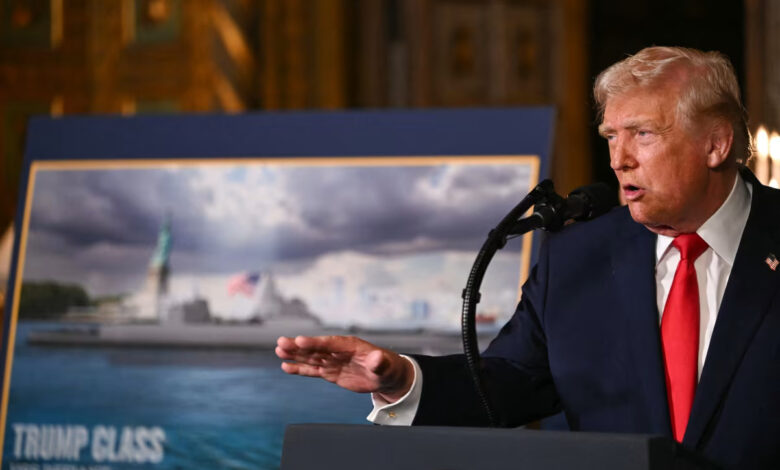
The president on Monday announced a new generation of battleships bristling with new missiles, nuclear weapons and lasers. Inevitably, these will be “Trump Class” vessels, extending his spree of naming things after himself.
Last week, Donald Trump’s handpicked new board of the Kennedy Center for the Performing Arts voted to put his name up alongside that of the assassinated former president. Trump unconvincingly confessed he was “surprised” by an honor he’d been hinting he craved for weeks.
Not long before that, the president showed up at the newly named Donald J. Trump Institute for Peace. He’d previously gutted the now-Potemkin agency — which the law said was independent and federally funded, and not his to destroy.
Next year, people will be able to buy pharmaceuticals from TrumpRx. Parents will be able to open “Trump Accounts” for newborns. Rich foreigners can buy Trump Gold Card visas. The president is building a new ballroom at the White House. It would be a shock if it’s not eponymous.
The “Trump class” ships are projected to take their place in the “Golden Fleet” as a maritime complement to the “Golden Dome” anti-missile shield that Trump also envisages to protect the denizens of the new “Golden Age” he says the country is enjoying.

A questionable procurement
The case for the new battleships is likely to spark great debate. Trump is correct that the US Navy has been falling behind China in its inventory of vessels and that the procurement process for new ships is notoriously expensive and slow. If he can improve that, he’ll leave a worthy endowment for the US on the high seas.
Still, some experts believe massive ships are a romanticized relic of the past best left in the epic 1950s documentary “Victory at Sea,” which immortalized US World War II maritime heroism and which Trump mentioned on Monday. In an age when Ukrainian drone boats devastated the Russian Black Sea fleet and of hypersonic weapons, the US might benefit from smaller, faster and more nimble ships. Trump’s wish to be in on the design of his battleships because he’s an “aesthetic person” also seems like an odd way to run a navy.
But to be fair to the president, he doesn’t just see the new fleet as a personal tribute, but as “unmistakable symbols of national power” and a source for many US manufacturing jobs.
Presidential legacies take decades to play out. So it’s too early to say whether the Trump class of ships will redefine naval warfare and establish him as a visionary, or whether they might turn out to be costly flops like some business ventures and casinos that bore Trump’s name or short-lived billionaire’s toys — like the Trump Shuttle airline or the Tour de Trump pro cycling race?
‘For centuries’ Americans will thank Trump: Hegseth
Trump’s announcement in his winter palace at Mar-a-Lago said so much about him. It brimmed with hyperbole and obligatory tributes from subordinates. And, by etching his name in history again, he highlighted his personality cult.
“These are the best in the world. They’ll be the fastest, the biggest and by far, 100 times more powerful than any battleship ever built,” Trump said.
Defense Secretary Pete Hegseth, meanwhile, argued that the new vessels would leave future Americans in his boss’s debt. “For decades, for centuries, the American people will look back and thank President Trump for having the vision and the willingness to invest right now in capabilities we need.”

It’s not normal for presidents to name things after themselves. They usually have the modesty to wait for history’s judgment and for a grateful nation to honor their service. Aircraft carriers named after John F. Kennedy and Gerald R. Ford were laid down years after they died. President Joe Biden announced in January that future carriers would be named for presidents Bill Clinton and George W. Bush.
The Navy has a long history of honoring its own.
The type of ships that the Trump class will presumably help replace, the Arleigh Burke class, were named for a courageous admiral who led packs of US destroyers in the Pacific war, revolutionizing naval tactics. The Navy also has a ship that memorializes the naval heritage of one of Trump’s greatest political foes, John McCain. The ship was originally named for the late Arizona senator’s father and grandfather, both admirals. But it was later rededicated to add him as a namesake.
In 2019, CNN reported that the White House asked the Navy to make sure the USS John S. McCain was not visible during a visit by Trump to Japan in his first term. The request was deemed impractical by top Navy brass.
The second Trump administration had previously been more about taking names off ships. Hegseth stripped a Navy oiler of the name Harvey Milk, which honored a gay rights activist, as part of his campaign to eradicate “woke garbage” and to restore the “warrior ethos” to the armed forces.
‘You’ve got to put your name on stuff’
A man known for Trump Tower, Trump hotels and Trump golf resorts worldwide may have offered a clue to his talent for immortalizing himself in stone — and ships — during a tour of George Washington’s Mount Vernon in 2018.
“If he was smart, he would’ve put his name on it,” Trump said of the estate, according to a report by Politico. “You’ve got to put your name on stuff or no one remembers you.” Mount Vernon president and CEO Doug Bradburn reportedly then told Trump that the first president managed to get his name on the nation’s capital, prompting him to laugh and concede a good point.
Trump isn’t waiting for history to render judgment on his two terms. His first year back in the White House has showcased his desperation to dominate attention in the present and apparent terror he won’t be remembered in future.
Often, however, this comes across as immodesty and hints at insecurity in the most powerful man in the world. Foreign leaders long ago worked out that the best way to please Trump is to feed his need for exaggerated shows of respect — hence the stream of lavish state dinners; compliments; made-up awards like the FIFA Peace Prize; and gifts that flow in a torrent, like a multimillion-dollar jumbo jet from Qatar.

Some of Trump’s critics also argue that his obsession with altering the landscape with grand architectural projects to immortalize his own name hints is a worrying sign in one who disdains democracy and idolizes despots. They decry his overhaul of the White House — including his tearing up of the Rose Garden to build a Mar-a-Lago-style patio and his demolition of the East Wing for his ballroom.
Trump’s new presidential walk of fame between the White House and the mansion, which includes gold framed portraits of his predecessors and plaques filled with juvenile social-media style insults about their records, have raised questions about the 79-year-old president’s state of mind.
And Trump’s penchant for having his name everywhere is often jarring. White House press secretary Karoline Leavitt, for example, strangely offered “congratulations” to Kennedy, who was murdered in 1963, for having his name joined by Trump’s on the outside of the Washington, DC arts center.
But the outrage Trump stirs among liberals and the media is a classic tactic to delight the supporters who love him.
More seriously, Trump’s attempts to make his name ubiquitous are a window into his questionable view that the presidency grants him unfettered powers to do anything that he wants.
And it has long been obvious that Trump partly sees the presidency and its vast powers as a vehicle to promote himself — even when it means putting his own name on another man’s memorial.
His naming binge also comes with political risks at a time when millions of Americans are struggling to cope with high prices for groceries, housing and health care. Trump is making it easy for his critics to argue that he’s most concerned with his personal priorities and not those of Americans. This may explain his eroding approval ratings and the plunging public confidence in his economic management.
Ultimately, Trump’s affixing of his name on a new class of battleships is just one of the thousands of extraordinary twists in two terms that shattered expectations for how a president should behave.
He could spend the next three years putting his name everywhere. But it will be just as easy for the next Democratic president to erase it from buildings and ships.
Fine presidential legacies are forged in deeds. Washington’s greatest legacy was not that he gave his name to his new country’s capital, but that he consciously refused to behave like a king.