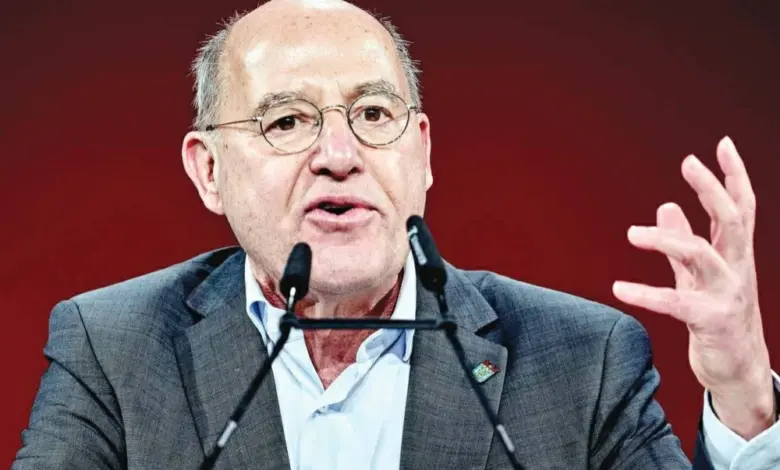
Al-Masry Al-Youm sat down for an interview with prominent German lawyer, author, and left-wing politician, Gregor Gysi.
Gysi holds the record for the longest continuous service in the German Parliament (the Bundestag) in addition to leading the Socialist Unity Party of Germany in East Germany before reunification, and serving as a member of the European Parliament.
He led the parliamentary opposition during Angela Merkel’s third government, and founded and led the German Left Party (Die Linke) before voluntarily stepping down from the leadership, choosing to remain solely a Member of Parliament.
Gysi is vocal in his opposition to Trumpism and its contempt for international law, as well as the destruction of the middle class. He advocates for fair taxation on the wealthy and opposes austerity measures concerning spending on education, health, culture, art, and training.
Furthermore, he demands justice for pensioners and immigrants.
■ In Germany and Europe nowadays, one often hears the term “farewell to the welfare state”. What does the population lose with this, or what has it already lost?
Attempts to reduce the welfare state and its benefits are mainly associated with the loss of social security. The fact that over a million people are homeless in Germany today makes it clear how seriously human dignity is endangered and violated by this policy.
■ Is the welfare state fading because resources are dwindling or because politicians have become more inefficient and distant from citizens?
This loss of the welfare state is propagated above all by parties that reject a fair tax system: i.e. the appropriate participation of people with high incomes and wealth in the financing of the community.
Ultimately, it is about a redistribution from poor to rich.
The welfare state no longer seems to be so necessary to them, since it is no longer needed for the confrontation with socialist countries.
■ You are optimistic about the possibility of far-reaching reforms in the areas of education, health, culture, training, taxes and pensions. Is it really possible to change the conditions in view of the party political differences in Germany?
We must fight for democratic majorities for a policy of social justice and raise awareness amongst the population that such a policy needs their support.
This is not easy, but it is possible as examples from federal states repeatedly show.
■ Supporters of budgetary discipline at the expense of social programs are becoming louder within national economic councils worldwide. How can a different policy secure resources for social reforms and expenditure cuts?
It is mainly business associations and lobbying organizations of wealthy people that repeatedly suggest that the welfare state can no longer be financed and, however they pursue no other goal than to prevent the necessary redistribution from top to bottom.
■ While Europe – voters, politicians and institutions – seems at a loss, we were shocked by the result of the New York mayoral election and its announcement of free local transport, affordable housing and fixed rents. Could a new vision for the welfare state emerge from the US, the “land of individual dreams” in the coming decades?
At the federal level, the US is taking the opposite path under Trump.
However, Zohran Mamdani‘s clear election victory shows that the people are enthusiastic about a path of social justice and social balance. It remains to be seen whether the Democratic Party is able to take up this impulse and make it fruitful for the US.
■ Some argue that Germany isn’t just losing its welfare state, but is also slipping as a major industrial power, falling behind in terms of research and technology. Is this accurate, and if so what is being done to address this?
To this day, prevailing policies set highly inadequate frameworks to promote the innovative strength of companies. For key industries such as the automotive industry, corporations have rested too long on the laurels of the past.
■ Until now, we knew of the so-called middle-income trap, but now we seem to be facing the high-income trap – a high standard of living that no country can maintain, let alone increase. Could Germany, Britain, France, Poland and others fall into this trap?
The problem in Germany is that the middle class pays for everything, as you can no longer cut anything in the lower classes. Prevailing politics do not dare approach those with high incomes, the wealthy and corporations.
We must maintain standards of living and social cohesion to ensure provide social balance.
■ You mentioned in the opening session of the Bundestag that even some African countries have overtaken Germany in terms of the Internet and digital transformation. Why did this happen?
This is more a question of state investment in infrastructure. In Germany, this has been driven to wear and tear in most areas in recent decades and a necessary modernization has been postponed. This also especially concerns the possibilities of digitization.
■ What do you think of the current statements about technological enslavement, which is being imposed on others, especially by technologically advanced countries such as the US and China?
It is always a problem when certain developments are determined by individual states or even depend on specific development.
This is why open source projects must be funded.
■ Trump and his team are attracted to the Chinese authoritarian structure. However, how do you see the future of this Chinese authoritarian model at a time of open and covert authoritarianism spreading in many democratic countries? The most recent example being Argentina.
China’s social model has proven to be very resilient over the years.
The global trend towards authoritarian structures reinforces this impression. The Chinese leadership has used short decision-making paths to make China the second largest economic power in the world. It is possible that it will also overtake the US.
The question will be whether the Chinese leadership will overdo its geopolitical ambitions on this basis.
■ How convinced are you of the role of Germany, Britain, France and Italy in the October 7 attack and brutal aggression of Israel against Gaza and the West Bank? Does Europe still have a role to play in the peace process towards a two-state solution?
It is almost only Europe that is sticking to the two-state solution.
There are certainly some differences in the approach of the aforementioned states to the conflict. As Europe is not speaking with one voice, it has lost weight in resolving the conflict.
However, it can certainly play a role as a mediator between the Arab states and Israel. The prerequisite is that Hamas and other terrorist structures are withdrawn from all support and that Israel is pressured to agree to the two-state solution.
■ The Arab region is under pressure to participate in Abraham’s agreements, real estate deals, or even Defense networks. What kind of agreement do you think this troubled region needs to be able to live like the rest of the world?
If you want to achieve lasting peace and a prosperous development based on it in the Middle East, you will not achieve it through a business deal. All agreements must ultimately aim to give people a real perspective and not to serve geopolitical and capital interests.
■ Trump has singly dominated many issues in the Middle East to the point that Germany, for example, hesitates to take on a role in Syria. Shouldn’t Germany at least be involved in the reconstruction of Syria to help address the refugee crisis?
Syria’s reconstruction is a mammoth task that will not be possible without international help. But it could become an example for the whole Middle East of how to balance interests. Germany should indeed actively participate in this.
■ Some say Trump’s peace plan for Gaza is a new Balfour declaration for Palestine. What is your opinion on this? And can Europe seriously contribute to the reconstruction of Gaza?
Trump’s plan may at least keep the weapons silent. But the situation in the West Bank already shows that the plan really lacks a perspective. I only see a perspective in the two-state solution. This is also why Balfour cannot be a model. The Jewish state exists.
Now the international community must push for a independent and viable Palestinian state in which terrorist organizations are no longer allowed to play a role.
■ We have criticized the populist right in countries like Italy, but it seems to have achieved some success there. My question is: How is the Alternative for Germany party different from the Italian populist right?
Ms. Meloni is head of Italy’s government, and I can only hope that Alice Weidel will never become a Prime Minister like her.
■ The left has become accustomed to divisions as if it were part of their DNA. Will the situation in Germany change in the face of the heated social debates in the coming period, and will the original socialist party back down?
Anyone who decides to leave a party has reason to do so. I can’t see any ambition to return to the left at the Sahra Wagenknecht Alliance (BSW). My party has taken a seen a remarkable upswing after the separation, and we are working to expand.
The BSW is increasingly oriented to the right in everything.
■ You represent a strong and courageous position for a system of peace and security in Europe that includes Russia. Has there been progress on this path in recent months? Is Russia the obstacle, or is it Putin alone?
Lasting peace and security in Europe will not be achieved without and certainly not against Russia. With the war against Ukraine, Russia has decided to enforce its interests beyond international law with military force.
This cannot be the basis for a system of collective security.
■ Why are Europe’s concerns about Russia not clear to many in our region?
Because Russia very skillfully reminds the region of colonial and neo-colonial times, which have left lasting scars. This belief that the world must only develop as the West wants it to is still alive in NATO and the EU.
As long as equal international relations are not championed, this will unfortunately remain the case.
■ Is Germany’s distancing from Russian energy resources a clever move, as politicians in Germany, the Baltic States and the US see it, or does it undermine the possibilities for real cooperation that once existed?
It remains to be said that Putin has turned off the gas tap. Since then, Germany’s favorable energy supply is now history.
Russia is not insignificantly financing the war through its oil and gas exports. However, the sanctions are worthless. There are also sanctions against India and China.
Against the background of the climate crisis, all exporters of fossil fuels will have to rethink their business models in the foreseeable future anyway.
In the German Democratic Republic, it realized that a supply policy was much more effective than the previous sanctions policy.
■ Germany seems to be relatively uninvolved in Bitcoin and cryptocurrency markets as well as gold speculation. Doesn’t the Left Party have a vision of what the global financial system should look like in the future?
The trend to increasingly decouple money traffic from real production increases the risk of systemic crises immensely. In the US, a bursting of the tech bubble is feared with serious effects on the global economy.
Nevertheless, it will probably not be possible to stop the trend. Therefore, it must be possible to give states and their social systems the opportunity to draw profits from cryptocurrencies and speculation through international agreements with appropriate taxation.
■ Since Egypt has recently dealt with international institutions to reform its economy, I would like to ask you for your assessment of Germany’s role in Greek economic aid, especially in view of the fact that politicians such as Varoufakis have strongly criticized this role.
Germany played a critical role at the time, even benefiting from the crisis on a large scale and forcing Greece to make profound cuts in the social system. That was a mistake.
■ Can Germany support the initiative of Egypt and other countries to reduce the debt of emerging and developing countries?
Germany absolutely has to do so, because this is the only way to achieve equal development and combating the causes of migration.
■ The latest strategic cooperation agreement between Egypt and Europe was preceded by a free trade agreement with the continent and the Barcelona process, to which Egypt belongs. Do you see the possibility of a profound Egyptian-European cooperation that goes beyond considering Egypt as the main source of migration?
This is one of the central problems that Europe, or the rich industrialized countries as a whole must understand – that we must solve human problems together and not at the expense of the so-called Third World.
■ In your judgement, will Germany be able to stick to its attitude towards stopping arms exports to Israel?
The federal government has now cancelled this ban. Against the background of German history, I think it is wrong that Germany makes any money at all by exporting weapons.
■ How does the German left react to President Erdoğan’s undemocratic action against his opponents, especially against Istanbul’s mayor İmamoğlu?
We strongly criticize this and call on the German government to clearly tell NATO member Turkey that this policy will not be accepted and tolerated.
■ Immigration is clearly an important concern for Germany, which needs hundreds of thousands of skilled workers. Could there be new Egyptian-German cooperation in this area?
That would be a sensible option. But when you need 400,000 skilled workers from abroad every year, it is not particularly wise to explain migration to the “mother of all problems”. The Christian Democratic Union of Germany and the Christian Social Union in Bavaria act on this issue with a short-sightedness that is totally wrong.
■Your observation of the shift of the Defense industry to the private sector in most countries in the world is extremely worrying. How can we curb this alarming trend?
If at all, the Defense industry must be organized by the state so that no one can earn from wars. Unfortunately, we are far from this, and moving further and further away.
■ Germany and the whole of Europe are once again faced with the classic economic question: butter or cannons? Or put it another way: What are the priorities of public spending? Will Germany succeed in finding a balance that the rest of Europe has apparently already achieved?
Even the question is an anachronism. One should have learned from history that one can neither win peace nor organize social welfare with cannons.
■ Social inequalities are increasing enormously worldwide, and you pointed out that the tax burden for the average family in Germany is higher than for billionaires. Are the OECD’s tax reforms sufficient, or does the world need other approaches, such as a wealth tax?
In Germany, the wealth tax could be introduced again with a simple majority of the Bundestag. There is a lack of political will to at least slightly straighten out the now dramatic imbalance between rich and poor. A European or even more global tax would be a possibility, because it reduces the possibilities of looking for tax loopholes. But this is even more difficult to achieve.
■ How can Germany revitalize the model of community schools in order to ensure equal opportunities for children in education, sport and culture?
The community school is now available in a number of federal states. Schooling is a matter of federal states (Bundesländer) in Germany. That makes it complicated. And educational reforms need their time. But the benefits of longer learning together are increasingly being recognized.
■ As German exports increase year after year, it did not seem to care about the shortcomings of the multilateral world trading system. Does this system now deserve Germany’s attention in order to contribute to its reform?
Trump’s customs policy shows how fragile the world trade system is.
On the other hand, economies are now so intertwined by globalization that such attempts to erect trade barriers immediately backfire.
It is crucial that we also move away from “might makes right” in trade policy towards a balanced approach that enables economic and social development for all countries.
■How do you assess the Chinese approach to mediation between Iran and Saudi Arabia in the Arab region, and what lessons can Europe learn from this to promote diplomacy instead of sanctions?
China’s actions have at least made it possible to bring the long-standing tensions between the two states and the struggle for supremacy in the region into a framework that makes punctual understanding possible and includes prospects for a reduction of reservations.
Sanctions usually do not achieve their goal and are associated with many problems, some of which fall back on their authors.
Timely diplomatic intervention, ideally under the umbrella of the United Nations, can detect conflicts at an early stage and promote their civil solution.
■ As a lawyer who is committed to freedom, how do you assess Egypt’s role under Sisi’s leadership in 2025 in the mediation between Israel and the Palestinians and in preventing the expulsion of the population from Gaza?
Egypt has played a major role and has shown itself to be an important mediator in the region.
It will now be crucial to show the people of Gaza a social and economic perspective and support them in their development, as hopelessness and economic hardship attract terrorist groups.
Egypt must also pressure Israel to change its policies towards the Palestinians.
■ Final question: On the occasion of the opening of the Great Egyptian Museum, an Egyptian friend with German citizenship proposed that Germany should voluntarily exhibit the Nefertiti bust in Egypt during the cold winter months, when tourism in Germany stagnates and Egypt is in high season, without waiting for a decision on the ownership of the bust. This is a new sign of cooperation between the two countries. What do you think?
That’s an interesting idea. If it can be guaranteed that the Nefertiti bust survives the round-trip transport without damage, this might even be a way for a permanent agreement, so that the question of ownership loses weight.
In a figurative sense, this would be a diplomatic solution.