Archaeologists have unearthed an ancient Egyptian pleasure boat off the coast of Alexandria, matching a description given by the first-century AD Greek historian Strabo, according to the British newspaper The Guardian on Monday.
The 35-meter-long pleasure boat dates back to the first half of the first century AD and was built to accommodate a central wing with a lavishly decorated cabin.
The boat was found near the now-sunken island of Antirhodos, which was once part of the greater port of Alexandria, known as Portus Magnus.
Ancient evidence
Strabo visited Alexandria between 29 and 25 BC and wrote of such boats: “These vessels were luxuriously furnished and used by the royal court for outings, as well as by revelers traveling from Alexandria through the canal to public festivals. Day and night, the boats were filled with patrons playing the flute and dancing without restraint and with great immersion.”
The excavations were carried out by the European Institute for Underwater Archaeology under the direction of visiting maritime archaeology professor Franck Goddio, from Oxford University.
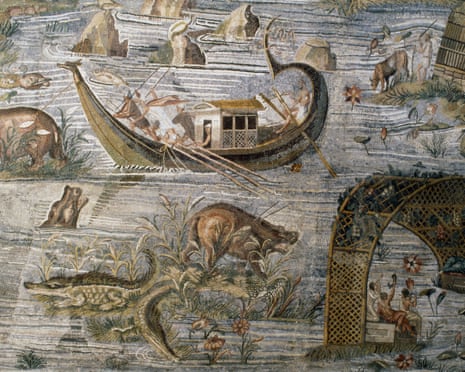
Goddio told The Guardian: “It’s very exciting because it’s the first time ever that a boat like this has been discovered in Egypt. These boats were mentioned by various ancient authors, such as Strabo, and they were also depicted in some works of art, for example, in the Palestrina mosaic, where a similar but much smaller boat is shown, accompanied by nobles hunting hippos. But nothing like this [actual boat] has ever been discovered before.”
A major finding
While the mosaic depicts a boat about 15 meters long, the recently discovered boat is much larger, judging by its well-preserved wood, which also measures nearly seven meters wide.
It likely would have required more than 20 oars. The boat was submerged by only seven meters of water and buried 1.5 meters below the sediment.
Goddio initially thought there were two ships stacked on top of each other “because the construction was so unusual.”
The recent discovery lies less than 50 meters from the site of the Temple of Isis, where Goddio was excavating. It is believed the boat may have sunk during the catastrophic destruction of this temple around 50 AD.
Following a series of earthquakes and massive tidal surges, the great port of Alexandria and parts of the ancient coastline sank beneath the sea, swallowing up palaces and other buildings.