Egyptian Minister of Water Resources and Irrigation Hani Sewilam reaffirmed that his country retains all measures guaranteed under international law to safeguard its water security, stressing that “all legitimate options” remain on Cairo’s table.
Sewilam characterized Egypt as a “strong nation of peace” that upholds international law, but noted it knows precisely when and how to respond appropriately to protect its national interests.
Cairo will not ignore its dependence on the Nile, he stressed, nor will it accept what he called “illusions of control and dominance” over water flows to downstream states.
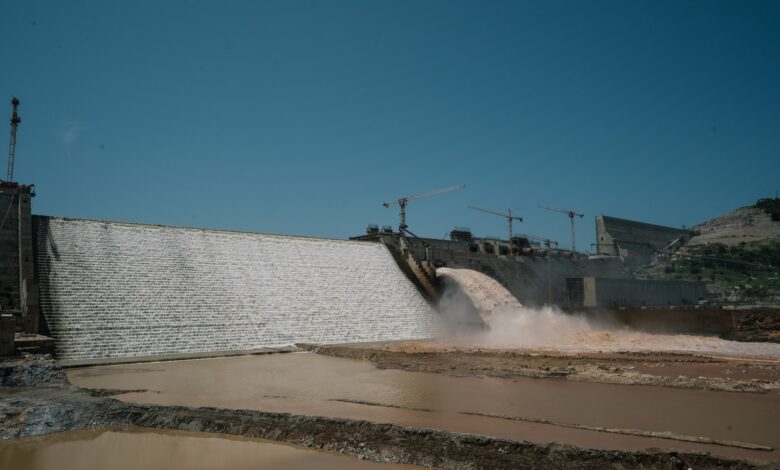
The minister explained that describing the Grand Ethiopian Renaissance Dam (GERD) as “unilateral and illegal” reflects a political position rooted in Egypt’s legal view regarding the dam’s solo construction, filling, and operation.
He added that the completion of construction or the passage of time does not imply Egypt’s acceptance of a done deal, nor does it extinguish its rights or legal standing.
The statement comes as Cairo continues to press for a binding legal agreement governing the filling and operation of the GERD amid persistent concerns over downstream impacts.
In July, the Water Ministry disclosed that solo operations had led to fluctuating discharge rates, exacerbated by the absence of clear operational rules and routine data-sharing mechanisms among Egypt, Sudan, and Ethiopia.
Sewilam warned that uncoordinated operations could trigger sudden discharge shifts—causing either acute spikes, which he termed “artificial floods,” or sharp drops leading to “artificial droughts”—potentially destabilizing water infrastructure and dam management across Egypt and Sudan.
Critique of unilateral control and alternative Nile models
Shifting narratives
Sewilam criticized recent Ethiopian statements regarding the control of downstream water flows, arguing they contradict past assertions that the GERD is merely a hydroelectric project and reveal ambitions to enforce single-handed control over a transboundary river.
Support for equitable development
The minister emphasized that Cairo does not oppose development across the Nile Basin, provided projects align with international law and preserve Egyptian water security.
The Southern Nile Basin model
He highlighted the collaborative approach in the southern Nile Basin—where nations study, notify, and consult on projects prior to funding and execution—noting Egypt actively supports and helps finance development under this framework.
Rejection of fait accompli
Sewilam contrasted this cooperative model with the GERD’s unilateral approach, asserting Cairo will not allow a new fait accompli to be imposed on the Eastern Nile.