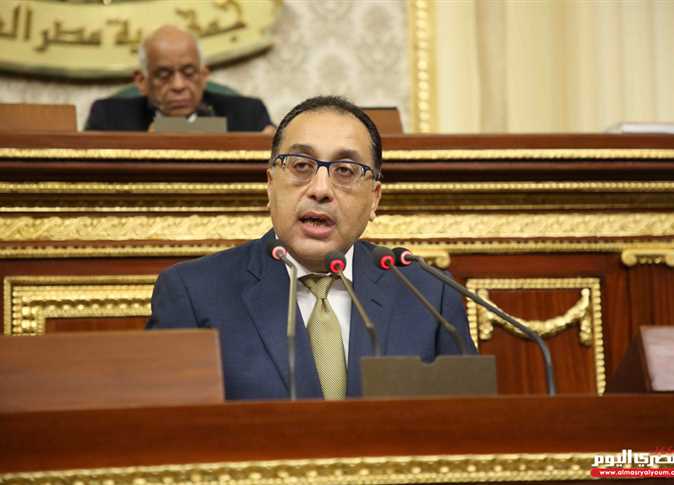
Prime Minister Mostafa Madbouli chaired a meeting of the Central Crisis Management Committee on Tuesday to follow up on the repercussions of the ongoing military escalation in the region.
The meeting was attended by Deputy Prime Minister for Economic Affairs Hussein Eissa, Governor of the Central Bank of Egypt Hassan Abdalla, Minister of Electricity and Renewable Energy Mahmoud Esmat, Minister of Finance Ahmed Kouchouk, Minister of Tourism and Antiquities Sherif Fathy, Minister of Supply and Internal Trade Sherif Farouk, Minister of Foreign Affairs, International Cooperation and Egyptian Expatriates Badr Abdelatty, Minister of Petroleum and Mineral Resources Karim Badawi, Minister of Investment and Foreign Trade Mohamed Farid, Minister of Planning and Economic Development Ahmed Rostom, Minister of Industry Khaled Hashem, Executive Director of the Egypt’s Future Authority for Sustainable Development Bahaa al-Ghannam, along with other officials.
The meeting reviewed a report prepared by the committee’s technical secretariat on key economic and political developments related to the current crisis, including potential impacts on the global and domestic economies based on various conflict scenarios.
The report highlighted expected repercussions on major economic indicators, energy supplies and global oil prices, as well as supply chains, international trade flows, and global economic growth rates.
Regarding domestic impacts, the committee reviewed outputs from a monitoring platform launched by the Information and Decision Support Center, which provides daily indicators tracking commodity prices and stocks, global oil prices, navigation in the Suez Canal, foreign exchange rates against the Egyptian pound, and electricity production and consumption.
The meeting also reviewed measures implemented in line with presidential directives to address the crisis, particularly in the economic and energy sectors, including monitoring global and local markets.
Cabinet spokesman Mohamed al-Homsany said the CBE governor reviewed developments regarding securing financing needed to meet the country’s requirements of essential goods and production inputs, as well as foreign currency inflows and the provision of hard currency to the private sector to ensure uninterrupted production and market supply.
He added that current foreign reserves provide the Egyptian economy with a degree of flexibility to absorb external shocks and deal with the repercussions of the crisis.
The meeting also reviewed ongoing measures to rationalize public spending across government entities in line with policies aimed at improving expenditure efficiency amid fast-evolving geopolitical tensions affecting global supply chains and trade.
The committee further examined a comprehensive report assessing the economic impact of regional crises on Egypt’s economy, along with proposed scenarios to address volatility in global energy markets while ensuring service sustainability and maximizing export opportunities to boost foreign currency resources.
On food security, the meeting reviewed the status of wheat supplies, noting that current strategic reserves are highly reassuring and sufficient to cover local demand for several months. He added that mechanisms to ensure stable supply and diversify import sources were also discussed in coordination with relevant entities.
The spokesman also said the meeting reviewed preparedness plans to secure sustainable natural gas supplies through diversified sourcing, as well as the operation of an integrated digital system for managing petroleum products to ensure governance, fair distribution nationwide, and accurate monitoring of consumption rates.
He stressed that current supply levels and strategic reserves of petroleum products and natural gas are secure and sufficient to meet the needs of vital sectors and the local market on a regular basis, ensuring system stability and resilience against potential disruptions.