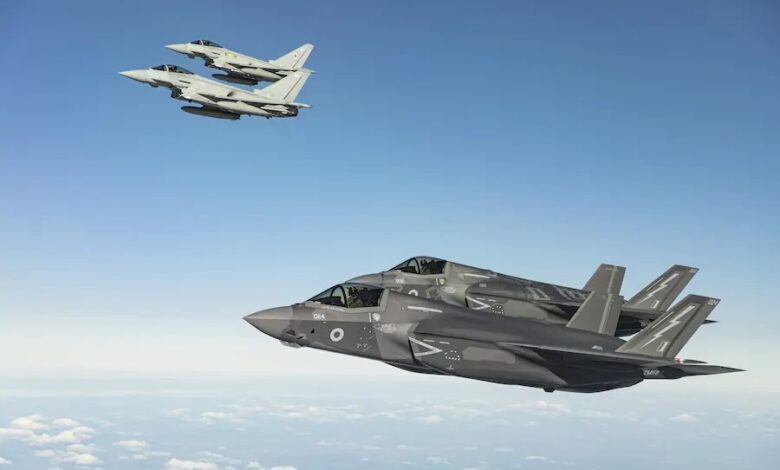
The British Ministry of Defense announced on Sunday that it had conducted defensive air patrols over several Middle Eastern countries.
The Ministry of Defense in a statement said that Typhoon and F-35 fighter jets had conducted patrols overnight, supported by Voyager aerial refueling aircraft.
The statement explained that these air operations were conducted to defend British and allied interests and included the airspace of Qatar, Cyprus, the UAE, Jordan, and Bahrain.
Potential British action
British Energy Secretary, Ed Miliband, revealed a possible British move in the Strait of Hormuz.
Miliband said on Sunday that Britain is considering sending ships and mine-hunting drones to the Middle East in an attempt to reopen the Strait of Hormuz, according to the British newspaper The Guardian.
He indicated that British ministers are discussing with their allies as to how the UK can help secure the vital waterway after US President Donald Trump called on Britain and other countries to deploy ships to the region.
“It is absolutely vital that the Strait of Hormuz is reopened, and we have already begun discussions with our allies, including the US, about this,” he said.
Miliband noted that “there are various ways in which they can contribute, including the use of drones to detect mines,” adding, “All of these things are being considered in coordination with our allies. Any options that could help reopen the strait are being examined.”
Miliband’s remarks came a day after Trump posted on social media calling on the UK, China, France, Japan, South Korea, and others to send warships to the region.
Trump calls for nations to send their ships
Trump wrote on his social media platform, Truth Social: “Many countries, especially those harmed by Iran’s attempt to close the Strait of Hormuz, will be sending warships, in coordination with the United States of America, to keep the Strait open and secure.”
He continued his claims about Iran’s capabilities: “We have already destroyed 100 percent of Iran’s military capabilities, but it is easy for them to send in one or two drones, drop a mine, or launch a short-range missile somewhere along or within this waterway, no matter how badly they are defeated.”
He added: “We hope that China, France, Japan, South Korea, the United Kingdom, and other countries affected by this artificial blockade will send ships to the region so that the Strait of Hormuz does not pose a threat from a state that has been completely decapitated.”
A vital passageway
According to The Guardian, about 20 percent of the world’s oil supply passes through the Strait of Hormuz. Its de facto closure at the beginning of the war led to a sharp rise in oil prices from about US$65 a barrel to about $100.
This surge caused great concern in Western countries, whose governments face the prospect of further increases in energy prices and inflation in general.
On February 28, Israel, along with the Trump administration, launched an attack against Iran that killed Supreme Leader Ali Khamenei, along with a number of senior leaders and hundreds of civilians and military personnel.
Tehran responded by launching missile and drone attacks against American interests in the region, as well as extensive targeting of Israeli military and economic sites.