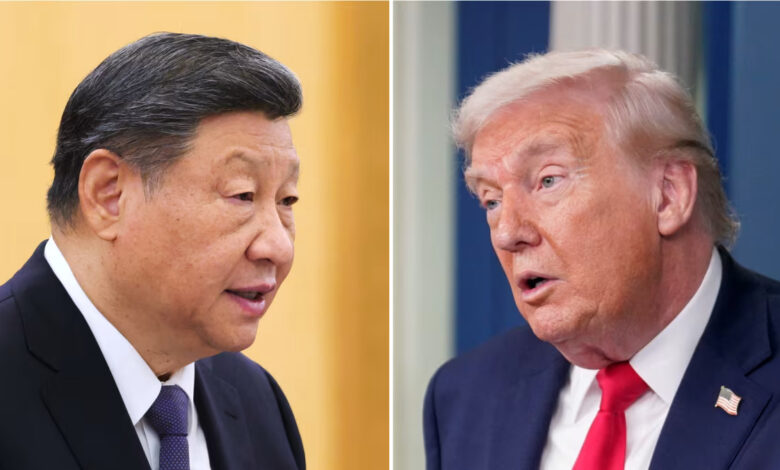
As US President Donald Trump primed his arrival in Davos by sowing discord with allies – ramping up threats to take control of Greenland, vowing to levy tariffs on opponents of that bid, and leaking private messages from European leaders – Beijing took the cue to position itself as an alternative global leader.
And there’s a growing audience willing to listen.
Hours after Trump’s broadside, Chinese Vice Premier He Lifeng took the stage at the annual Alpine meet to insist that Beijing “has consistently acted on the vision of a community with a shared future and remained steadfast in supporting multilateralism and free trade.”
“We’re upholding consensus and solidarity, and cooperation over division and confrontation, and providing China’s solutions to the common problems of the world.”

The comments, made as leaders braced for Trump’s arrival at the gathering, underscore China’s strategy to showcase itself as a calm, rational and dependable counterweight to the shock and awe of the Trump administration’s foreign policy.
Chinese leader Xi Jinping has for years called for a reshaping of a world order that he sees as unfairly dominated by the US and its allies – and is increasingly offering his own vision as an alternative, even as Beijing’s own neighbors have raised warnings of the country’s regional aggression.
Now, the logic echoing though Beijing policy circles is simple: China doesn’t need to go out of its way to chase gains in the global balance of power, it simply needs to stay its course while the US loses allies and credibility all on its own.
And that strategy appears to already be reaping dividends, as Trump’s rankling of US allies – as he refuses to rule out taking control of a Danish territory by force – drives forward the kind of threat to the US alliance system, and NATO in particular, that Beijing could have only dreamed of orchestrating.
China’s gain
To see that play out, look no further than the Davos address of Canadian leader Mark Carney, who – in a stunningly frank admission from one of the US’ closest allies – cast “American hegemony” as part of a fictional “international rules-based order.”
“We knew the story of the international rules-based order was partially false – that the strongest would exempt themselves when convenient, that trade rules were enforced asymmetrically,” Carney said in an apparent allusion, at least in part, to the US.
Carney’s message wasn’t framed as an embrace of China – the Canadian leader started out by alluding to a critique of the Soviet Union’s authoritarianism. But the rhetoric – which follows a year of Trump musing publicly about turning Canada into the 51st US state – has enough overlap with that of Beijing’s own playbook to mark a point on China’s board.

It also followed a more tangible win. Carney, during a fence-mending trip to Beijing last week, ushered in a new era of cooperation with China, launching a “strategic partnership” and relaxing Canada’s stringent tariffs on Chinese EVs it had implemented in lockstep with the US. (He also said that partnership would set the country up well for the “new world order” – a line that again appeared in step with China’s view that global change is nigh).
Other close US partners have also signalled an interest in moving closer to or mending ties with China as they hedge against the US. Britain’s Keir Starmer has pushed for more engagement with Beijing and on Tuesday his government approved the controversial construction of a new Chinese “mega” embassy close to London’s financial district.
Some of that diplomatic manoeuvring may be reluctant – driven by a realpolitik in which the US threat to the NATO alliance and erection of barriers around the American market are breaking old bonds and forging new ones. And it comes despite Western concerns about Beijing’s own ambitions, including when it comes to the self-governing island of Taiwan.
And in Beijing, that’s seen as exactly the kind of situation where China can gain, not only in terms of driving a wedge between the US and Europe, but pressing its own territorial claims and keeping its positioning in the global economy.
Countries across the world are staring into the expanse of China’s record $1.2 trillion annual global trade surplus – an imbalance analysts say threatens domestic industries everywhere, including in Europe.
While this threat got a name check by French President Emmanuel Macron in his Davos speech, the focus of European leaders at the gathering has clearly been torqued by Trump’s disruption of NATO, leaving less room to drum up solidarity on that economic front.
And China’s vice premier He used that opportunity to pitch China’s economic partnership to his counterparts and Beijing’s line that it “never seeks trade surplus” but falls victim to trade barriers on security grounds.
“China is a trading partner, not a rival, for other countries. China’s development presents an opportunity, not threat, to the world economy,” He said in his remarks.
And, according to China’s propaganda machine, Davos took that message well.
He’s “firm stance” was met with “sincere and enthusiastic applause” in Davos, one headline in Chinese state media read.